

Introduction
Artificial intelligence (AI) is becoming a useful tool for educators, offering new ways to plan lessons, develop activities and create learning resources. In early years education, AI can support teachers with ideas and preparation, while the educator remains responsible for creating meaningful, age-appropriate learning experiences. UNESCO’s AI Competency Framework for Teachers highlights the importance of keeping human agency at the centre of AI-supported education (UNESCO, 2024).
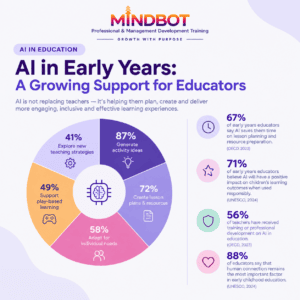
1. Generating Creative Learning Activities
AI tools can help educators brainstorm activities based on a particular topic, learning objective or classroom theme. For example, when planning a lesson about plants, a teacher could use AI to generate ideas for a nature walk, a planting activity, a story or an art project.
These suggestions can help educators save preparation time and explore different approaches. However, teachers should select and adapt activities to suit the children’s ages, interests and developmental needs.
2. Supporting Different Learning Needs
Children develop at different rates and may benefit from different ways of learning. AI can help educators adapt instructions, simplify explanations or suggest activities with varying levels of difficulty.
For example, a teacher planning a lesson about colours could ask AI for ideas involving visual resources, songs and hands-on activities. Educators should review these suggestions to ensure they are suitable and inclusive. UNESCO identifies inclusive and human-centred approaches as important elements of teachers’ AI competencies (UNESCO, 2024).
3. Creating Lesson Plans and Learning Resources
AI can assist with drafting lesson plans by organising learning objectives, materials, activities and reflection questions. It can also help educators create story prompts, worksheets and discussion questions.
Rather than relying on AI-generated plans without review, teachers should check that the content aligns with their curriculum and supports the intended learning outcomes. AI can assist with preparation, but the educator’s professional judgement remains essential (Miao & Cukurova, 2024).
4. Encouraging Creativity and Play-Based Learning
AI can provide ideas for storytelling, role-play, music, arts and crafts, and other play-based activities. For example, educators could use an AI tool to develop a simple story about animals, then invite children to act it out or create their own illustrations.
The educator’s role is to ensure that technology supports interaction, exploration and creativity rather than replacing hands-on experiences.
5. Using AI Responsibly in Early Years
Responsible use is particularly important when working with young children. Educators should check AI-generated information for accuracy, suitability and potential bias. They should also protect children’s privacy by avoiding the entry of names, photographs or confidential records into AI tools.
UNESCO’s framework emphasises ethical considerations and human responsibility when using AI in education (UNESCO, 2024).
Conclusion
AI can make lesson planning more efficient by helping educators generate ideas, adapt resources and organise activities. However, it should support not replace the knowledge, care and professional judgement of early years educators.
At Mindbot, we believe that continuous professional development helps educators build the confidence and skills to use emerging tools thoughtfully. With the right approach, AI can become a practical support for creative, inclusive and meaningful learning.
Mindbot – Growth With Purpose.